
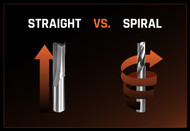
When setting up a high-throughput CNC nesting project, selecting your tool geometry isn't about finding a single "perfect" bit. It’s about choosing the right mechanical partner for your specific material. Both straight-flute and spiral helical router bits have distinct design profiles that serve completely different engineering roles on the shop floor.
To maximize your hourly shop throughput and reduce manual edge clean-up, it helps to understand how each tool profile interacts with different wood fibers and laminates.
Understanding Straight-Flute Geometry
A straight-flute router bit features cutting edges that run entirely parallel to the rotational axis of the tool shank. When the spindle rotates, the entire length of the cutting edge engages the workpiece simultaneously across the full width of the cut.
Best Applications for Straight-Flute Bits
Because a straight edge exerts forces solely in the horizontal and radial planes, it has no vertical (axial) pull. This neutral cutting action makes it excellent for specific tasks:
- Basic Edge Trimming and Sizing: Ideal for profiling solid wood or stable sheet goods where the edge finish is non-critical or will be treated later.
- Manual or Hand-Held Routing: The lack of vertical lifting force makes straight bits highly predictable and easier to control safely in manual table or hand-held operations.
- Cost-Effective Short Runs: For simple setups or low-volume projects where edge-sanding is already part of the workflow, straight bits offer an accessible entry-level investment.
Operational Considerations
Because the entire edge hits the material at once, straight bits create a repeating chopping action rather than a continuous slice. This simultaneous impact generates higher periodic vibration spikes, meaning they generally require sturdier spindle setups and slower feed rates on dense materials to prevent edge chatter.
Understanding Spiral (Helical) Geometry
A spiral router bit features helical cutting edges wrapped around a solid cylindrical core. As the tool rotates, the slanted edge enters the material sequentially at different axial depths. Instead of a sudden impact, the helical edge continuously shears through wood fibers and abrasive glue lines, smoothly distributing cutting forces and minimizing vibration.
Depending on your project requirements, spiral bits come in three primary configurations:
1. Upcut Spiral Geometry
Upcut spirals feature a right-hand helix that pulls chips upward and out of the cut, acting much like an auger.
- Best Projects: Deep mortises, pocketing, blind dadoes and heavy material removal in thick solid hardwoods.
- The Benefit: Maximum chip clearance keeps the cutting zone cool, preventing the thermal buildup that rounds over carbide tips.
2. Downcut Spiral Geometry
Downcut spirals utilize a left-hand helix to push the material fibers downward against the spoilboard.
- Best Projects: Shallow grooving, dadoing and profiling thin veneers or delicate laminates.
- The Benefit: It uses the uncut material below to support the top edge, leaving a perfectly clean top surface finish.
3. Compression Geometry
Compression bits combine both upcut and downcut spirals on a single solid carbide body. The tip pulls chips up, while the rest of the length pushes fibers down.
- Best Projects: Full-thickness CNC nesting of double-sided Melamine, plywood, MDF and high-end cabinet components.
- The Benefit: These opposing forces compress the top and bottom material fibers inward toward the center of the sheet, completely eliminating tear-out on both faces in a single pass.
Project Selection Guide: Matching Bits to Materials
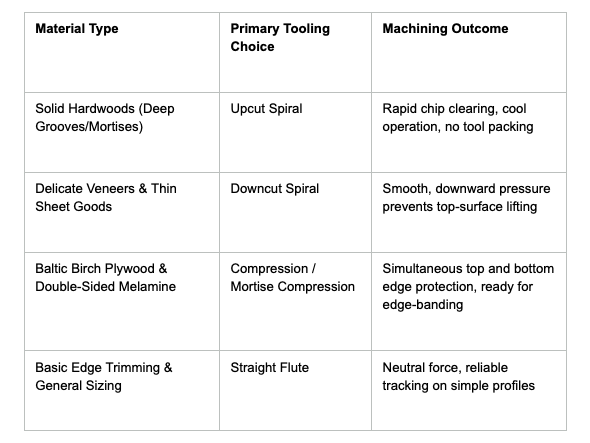
To optimize your throughput and edge quality, choose your tooling configuration based on your core material types:
Operating Parameters for Optimal Finish Quality
To ensure your chosen tool cuts cleanly rather than rubbing against the material, your CNC operator must maintain the correct chip load: the actual physical thickness of the wood chip removed by a single edge during one rotation.
Maintaining the correct feed rate relative to your spindle RPM ensures that heat is carried away inside the chip. Spiral tools excel here because they allow for much faster, continuous feed rates without tool deflection. However, if your CNC machine has acceleration limits that prevent you from reaching high calculated feed speeds, transitioning from a double-flute to a single-flute spiral tool cuts the required feed rate in half to achieve the identical chip load, keeping your tooling running cool and preserving your edge sharpness.
Explore our complete lineup of application-specific straight, upcut, downcut and compression tools at CleBitCo.