
Picture this: your nested-base CNC router is humming along, processing sheet after sheet of double-sided Melamine or cabinet-grade Baltic Birch. But as the parts come off the table, your operators immediately reach for the sandpaper. The bottom edge has a subtle, fuzzy tear-out, or the top resin layer shows tiny micro-chips along the cutline.
When edge quality fails on the shop floor, the instinct is often to blame vacuum hold-down pressure, spoilboard depth or mechanical slop in the gantry. But if your sheet isn't shifting, those aren't your real enemies. The true friction is happening on a microscopic level right at the tool’s cutting edge: you are likely running an improper chip load that is cooking your carbide and rubbing your material raw.
Why Low Feed Rates Kill Carbide
Machining engineered composites isn't just about spinning a bit fast and pushing it through a sheet. It’s about balancing mechanical shearing with heat management. Every time a cutting flute engages with a workpiece, it needs to slice off a discrete slice of material known as the chip load (measured in inches per tooth, or IPT).
When your chip load is tuned correctly, roughly 80% to 90% of the friction heat generated during the cut is absorbed directly into the ejected chip. The chip acts as a physical radiator, slinging heat away from the bit before it can soak into the metal.
However, when operators run their machine at high spindle speeds but back off the feed rate out of caution, the chip load drops below the critical edge radius of the bit. The flutes stop shearing cleanly and start rubbing.
The Three Thermal Failures of Bit Rubbing
- Thermal Shock & Micro-Fracturing: Temperatures at the cutting edge rapidly spike past 600°C. This extreme heat causes rapid expansion differences between brittle melamine face resins and the inner particleboard core, cracking the surface skin into tiny, jagged micro-chips.
- Carbide Binder Degradation: Extreme heat breaks down the metallic cobalt binder matrix that holds tungsten carbide grains together, causing micro-chipping and dulling the cutting edge long before its time.
- Resin Pitch Coating: Excess heat bakes wood glues and synthetic resins directly onto the flutes, building up a gummy layer that increases friction and accelerates tool wear.
Calculating your linear table feed rate comes down to three factors:
Feed Rate (IPM)=Spindle RPMNumber of FlutesTarget Chip Load
Instead of calculating numbers manually on a workbench notepad, you can instantly dial in your machine settings using our Speeds & Feeds Calculator.
The Solution: Engineered Geometry
Fixing edge tear-out requires matching the right cutting geometry with a carbide substrate capable of handling high feed rates.
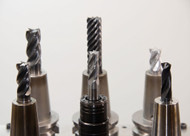
CleBitCo Mortise Compression Geometry
A standard upcut bit pulls material up into the vacuum, which keeps the bottom clean but blows out the top edge. A downcut bit forces chips down, preserving the top face but tearing up the lower surface. Standard compression bits combine both, but their bottom upcut tip is often 3/8" or 1/2" long. If you attempt shallow dado cuts or blind mortises, the downcut section never enters the board, leaving you with severe top-edge chip-out.
The Mortise Compression Bit addresses this with a shortened upcut tip (3/16" or 5/16"). Both opposing shear forces engage simultaneously even on shallow dado passes, compressing top and bottom surface skins inward toward the sheet's center core.
Don't Let Runout Ruin Your Setup
Even with calculated speeds and feeds, mechanical runout, or Total Indicated Runout (TIR), can compromise performance. When runout exceeds just 20% of your target chip load, tool life drops dramatically.
Actionable Collet & Spindle Care:
- Clean Collets Regularly: Wood dust and resin pack into collet slots, resulting in tool runout. Blow out dust with compressed air and ensure there is no debris in the spring collet slots.
- Replace Collets on Schedule: Precision collets suffer metal fatigue over time. Replace standard ER and precision collets every 400 to 600 machine hours (roughly every 2–3 months).
- Verify Shank Engagement: Ensure at least 80% of the tool shank is clamped within the collet bore to prevent bell-mouthing and excessive vibration.
The Impact on the Shop Floor
Optimizing speeds and feeds is an investment in direct shop profitability. By switching to a Mortise Compression bit, maintaining proper collets and dialing in chip loads, you can eliminate labor bottlenecks, triple your tool life and save nearly $1,500 for every 100 sheets processed.
Ready to eliminate edge tear-out and optimize your shop’s cost-per-linear-foot? Contact CleBitCo today to get the exact bits built for your machine.