

KEY TAKEAWAYS
- Hygroscopic Moisture Loss Overrides Thermal Vector: Indoor HVAC heating drops shop relative humidity from a summer baseline of ~60% down to 25% or lower. The resulting desorption of bound water drives cross-grain shrinkage that completely overwhelms minor thermal expansion, causing solid lumber parts to contract across the grain while remaining stable in length.
- Tooling Defects Mask Loose Tolerances Until Autumn: Using upcut bits across fibrous grain creates a "false interference fit" made of torn, swollen surface fibers that collapse when dry. Meanwhile, running downcut bits in deep mortises packs waste chips, generating frictional heat that causes tool deflection, tapered walls and burnished surfaces that starve PVA glue lines.
- Short-Upcut Geometries Protect Shallow Joinery: Standard compression bits feature an upcut tip length of 3/8 to 9/16 inch. Routing dados or grooves under 3/8-inch deep with standard compressions cuts entirely on the upcut tip, tearing top veneers. Switching to a mortise compression bit with a 3/16 or .1875-inch upcut zone engages the downcut flute in shallow cuts, delivering chip-free top edges without manual rework.
If you pull cabinet doors off the nested-base router in late November and notice that your mortise-and-tenon joints rattle, or that inset drawer fronts suddenly show wide, uneven reveals, it is easy to blame machine calibration or collet wear. But when the exact same toolpaths that produced tight, friction-fit joinery in July start loosening by late autumn, the issue rarely lies in your servo motors.
The friction starts as indoor heating kicks on. Cold outdoor air holds very little absolute moisture. When that air is pulled inside and heated, its relative humidity drops drastically, often plunging from a summer baseline of 60% down to 25% or lower. Wood is a natural hygroscopic material that desorbs bound water from its cell walls to reach equilibrium moisture content with the surrounding dry air. Because secondary cell walls shrink laterally as moisture leaves, solid lumber contracts significantly across the grain while remaining stable along its length.
A common question on the shop floor is whether ambient temperature itself causes this shift, or whether wood expands in heat or cold. Thermally, dry wood expands slightly when heated. However, the hygroscopic force of water desorption completely overwhelms thermal expansion by an entire order of magnitude. When the shop warms up in the fall, wood does not thermally expand; it contracts across the grain because moisture loss overrides the thermal vector.
If your team does not account for this seasonal moisture drop when selecting tooling and programming bit entry depths, machining defects will compound wood movement, turning minor material shrinkage into total joint failure.
The Physics of Seasonal Shrinkage: Solid Stock vs Engineered Materials
Understanding seasonal wood movement requires examining the material substrate. Solid hardwoods, plywood and reconstituted fiberboards handle seasonal relative humidity swings in completely different ways:
- Solid Hardwood (Tangential/Flat-Sawn): Experiences the highest rate of cross-grain dimensional change. As bound water leaves the cell wall, flat-sawn stock shrinks rapidly across its width.
- Solid Hardwood (Radial/Quarter-Sawn): Shrinks roughly half as much as flat-sawn stock because radially oriented wood rays act as internal structural reinforcement.
- Veneer Core Hardwood Plywood: Alternating 90-degree plies mechanically restrain in-plane movement, keeping length and width stable. However, does plywood expand and contract? Yes: unconstrained along its Z-axis, plywood exhibits thickness swelling and shrinkage identical to solid wood.
- Medium-Density Fiberboard (MDF): Isotropic with minimal in-plane dimensional change, but exposed edges absorb atmospheric moisture like a sponge, leading to severe edge-swelling and fuzzy kerfs.
To calculate cross-grain shrinkage for solid components, wood scientists use the standard USDA Forest Products Laboratory dimensional change formula, multiplying initial width by a species-specific dimensional change coefficient and the net moisture content change.
For example, a 36-inch wide flat-sawn Northern Red Oak panel machined in July at 12% moisture content that dries to 5.5% moisture content in a heated building undergoes a massive dimensional drop: it contracts by over 7/8 of an inch across its width. If that top is locked down with rigid pocket screws instead of slotted fasteners, the cross-grain tension quickly exceeds the wood's tensile strength, splitting the panel down the middle.
How Tooling Choice Compounds Seasonal Joint Failures
When a mortise-and-tenon or dowel joint loosens in November, the cut interface usually tells the real story. Selecting the wrong router bit geometry creates machining defects that artificially mask loose tolerances during the summer, only to expose them when autumn arrives.
The False Interference Fit
Running a standard upcut bit across the grain on fibrous species like Soft Maple or Yellow Poplar tears surface fibers rather than shearing them cleanly. In humid summer conditions, those crushed, fuzzy fibers swell. When the operator presses a tenon into the mortise, the swollen fuzz creates resistance, giving the illusion of a tight mechanical fit. Come November, those torn fibers dry out, lose turgor and collapse flat against the mortise wall. The artificial resistance disappears, widening the joint clearance by 0.010 to 0.020 inches and causing the joint to fail.
Deflection and Wall Taper
When routing blind mortises with 1/4-inch spiral bits, radial cutting forces cause tool deflection. If you use a downcut bit in a deep cavity, waste chips get packed tightly into the kerf. The bit recuts those packed chips, generating friction heat and forcing the cutter to flex away from the toolpath. This cuts a tapered mortise wall that is narrower at the bottom than at the top. Contact is limited to small high spots along the wall, which shear off under autumn contraction stress.
Surface Burnishing and Glaze Starvation
Running high spindle RPMs with slow feed rates causes the cutting edge to rub and burnish the wood surface. The heat smears plastified lignin over open cell cavities, sealing the wood. Water-based PVA glues cannot penetrate the glazed surface to create mechanical anchors. When cross-grain shrinkage pulls at the joint line in fall, the starved glue line separates cleanly from the burnished wall.
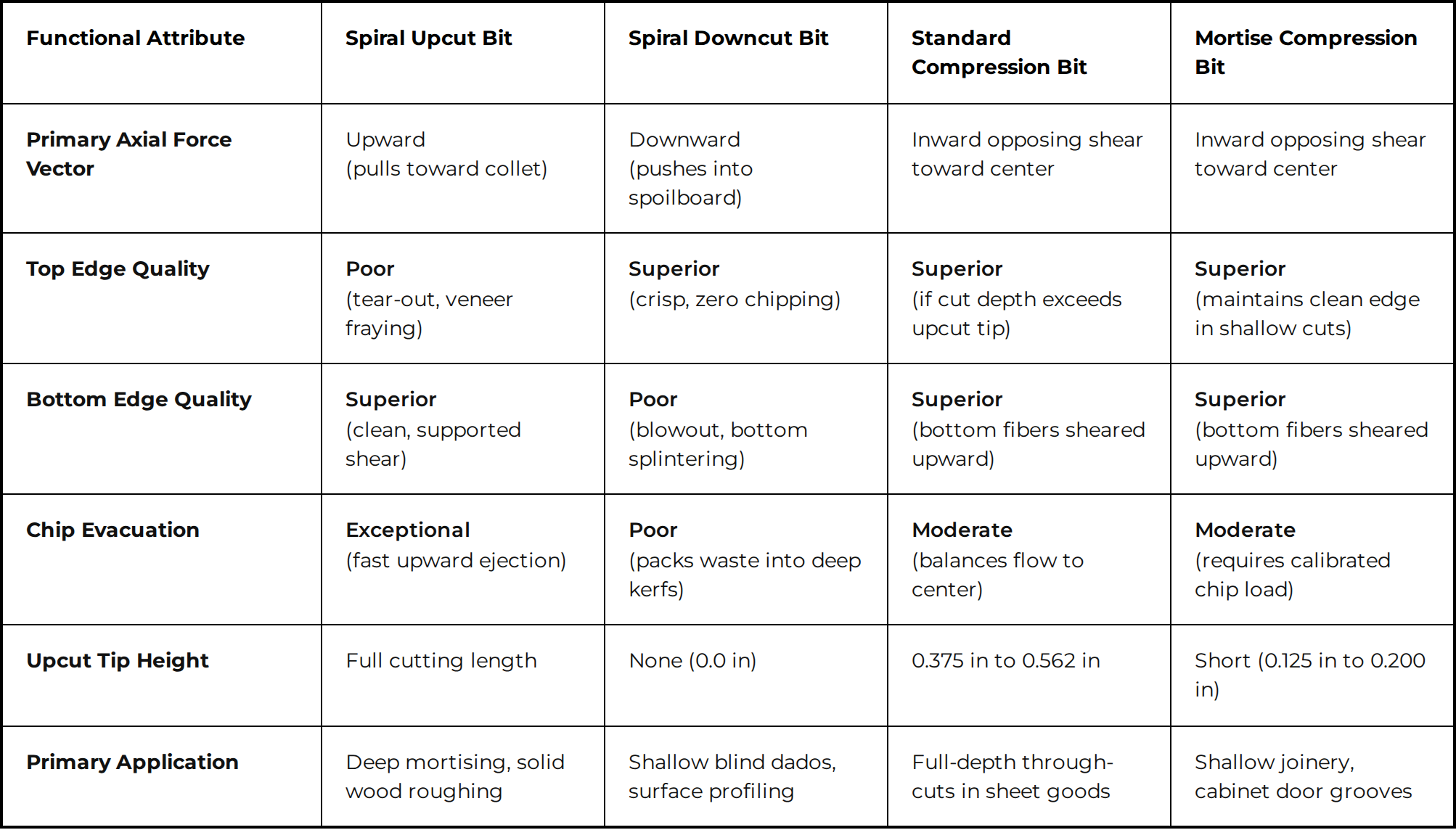
Tooling Selection Matrix: Matching Flute Geometry to Joint Depth
To keep joinery tight year-round, you must align tool architecture with the depth and profile of the cut.
The CleBitCo Strategy for Fall Production Wins
Optimizing joinery for seasonal movement requires combining proven shop floor practices with purpose-engineered tooling:
1. Stop Using Standard Compressions for Shallow Joinery
Standard compression bits have an upcut tip length of 3/8 to 9/16 inch. If you route a 1/4-inch drawer bottom groove or shallow dado, you are cutting entirely with the upcut tip, tearing out top surface veneers. Switch to a mortise compression bit. Designed with a short 0.1875-inch upcut transition zone, it engages the downcut flute on top surfaces at depths as shallow as 3/16 inch, leaving a sheared, razor-sharp top edge.
2. Use Spiral Upcuts for Deep Solid-Wood Mortises
When plunging deep blind mortises in hardwood, drop the downcut bit. Use a 2-flute solid carbide spiral upcut bit to pull chips cleanly out of the pocket, eliminating heat build-up, bit deflection and tapered walls.
3. Calibrate PVA Glue Line Clearances
Machined mortise-and-tenon joints require a total fit clearance between 0.003 and 0.005 inches. PVA glues are non-gap-filling; gaps wider than 0.008 inches reduce bond shear strength by over 50%.
4. Isolate Panel Movement in Cabinet Doors
When building five-piece frame-and-panel doors with router bits for cabinet doors, cut stile and rail grooves to a depth of 3/8 or 1/2 inch. Size solid wood center panels 1/4 inch narrow across their width, and insert 0.250-inch neoprene space balls into the stile grooves during assembly. As the panel shrinks in November, the elastic recovery of the rubber keeps centered pressure on the panel, preventing rattles without forcing the frame corners apart.
By running tooling engineered for specific joint geometries and accounting for seasonal material movement, you eliminate secondary hand-sanding, prevent costly field service calls and keep your cycle times running fast year-round.
Optimize Your Shop's Cost-Per-Foot
If you are ready to eliminate seasonal joinery failures, improve edge quality and stop wasting billable shop hours on manual rework and contact us at CleBitCo today.